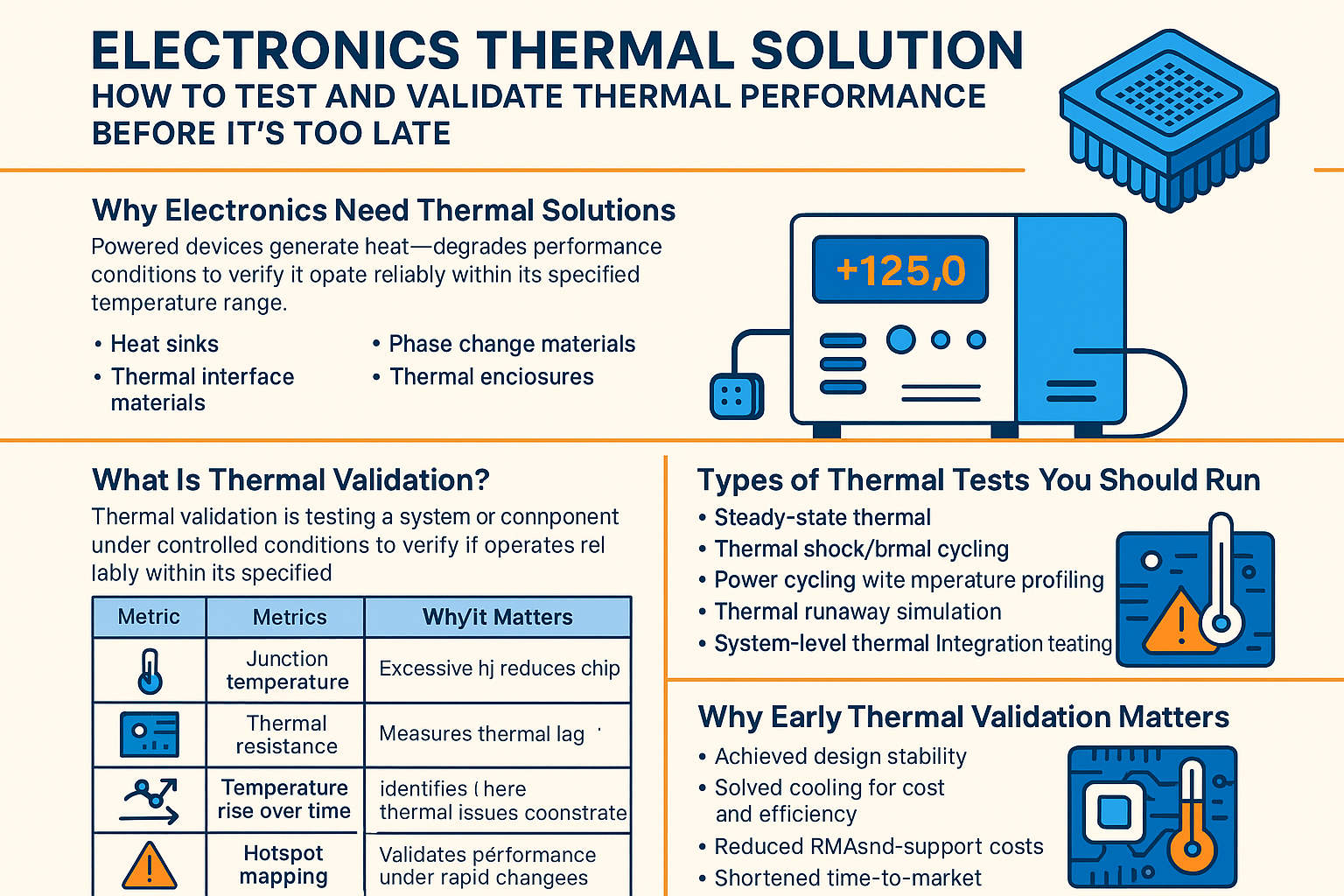
Modern electronics are faster, smaller, and more powerful than ever—but that performance comes at a cost: heat. Without a well-engineered electronics thermal solution, overheating can lead to system instability, reduced lifespan, or catastrophic failure. That’s why thermal validation is not a final checkbox—it’s a mission-critical process that must be built into every phase of electronic product development.
At Sysmetric-TFS, we specialize in thermal testing and validation systems that help electronics manufacturers, semiconductor designers, and R&D teams ensure their thermal solutions work under real-world conditions, before mass production.
Why Electronics Need Thermal Solutions
Every powered electronic device generates heat, from smartphones to automotive control units to AI chips. Without proper thermal management, that heat can degrade performance or damage internal components. Effective electronics thermal solutions typically include a combination of:
- Heat sinks and spreaders
- Thermal interface materials (TIMs)
- Active cooling (fans, heat pipes, TECs)
- Phase change materials (PCMs)
- Thermal enclosures or ventilation designs
These solutions are only as good as their validation. Just because a heatsink works in simulation doesn’t mean it performs well under real-world stress. That’s where thermal testing comes in.
What Is Thermal Validation?
Thermal validation is the process of testing an electronic system or component under controlled thermal conditions to ensure that it operates reliably within its specified temperature range. It includes:
- Measuring how fast heat builds up in critical areas
- Verifying that cooling systems respond fast enough
- Checking if thermal cycling introduces fatigue or failure
- Ensuring junction temperatures stay within safe limits
- Simulating worst-case thermal scenarios
Thermal validation is often part of broader reliability testing and is required for compliance with standards like JEDEC, AEC-Q100, UL, or MIL-STD.
Key Metrics to Test in an Electronics Thermal Solution
To validate the effectiveness of your thermal design, you need to test the following metrics:
| Metric | Why It Matters |
| Junction temperature (Tj) | Excessive Tj reduces chip life and increases leakage |
| Thermal resistance (RθJA / RθJC) | Measures how efficiently heat moves from the chip to ambient |
| Temperature rise over time | Identifies thermal lag and system responsiveness |
| Hotspot mapping | Reveals where thermal issues are most concentrated |
| Ramp rate and soak time | Validates performance during rapid environmental changes |
Sysmetric-TFS equipment offers precision temperature forcing systems and phase change cooling integration to test all these metrics with ±0.2 °C accuracy.
Types of Thermal Tests You Should Run
When testing your electronics thermal solution, here are the most common validation approaches:
- Steady-state thermal testing
- Confirms your system can hold a consistent temperature under normal operation.
- Confirms your system can hold a consistent temperature under normal operation.
- Thermal shock / thermal cycling
- Applies rapid temperature swings to simulate environmental stress over time.
- Applies rapid temperature swings to simulate environmental stress over time.
- Power cycling with temperature profiling
- Runs the device through high/low power states under controlled thermal conditions.
- Runs the device through high/low power states under controlled thermal conditions.
- Thermal runaway simulation
- Intentionally overheats components to identify design weak points.
- Intentionally overheats components to identify design weak points.
- System-level thermal integration testing
- Validates how your thermal solution performs inside the final device, with enclosure and airflow considered.
- Validates how your thermal solution performs inside the final device, with enclosure and airflow considered.
Sysmetric-TFS tools allow engineers to script these tests and record real-time data through Modbus, I²C, or custom interfaces.
Why Early Thermal Validation Matters
The cost of a thermal failure caught after production is 10–100× higher than one found during prototyping. Early thermal testing helps you:
- Avoid recalls or field failures
- Optimize your cooling solution for cost and efficiency
- Reduce RMA rates and support costs
- Shorten time-to-market by validating faster
Most importantly, it gives your design teams and product managers confidence that the electronics thermal solution really works—not just in theory, but under real stress.
How Sysmetric-TFS Helps Validate Your Thermal Design
At Sysmetric-TFS, we provide a range of thermal validation tools designed specifically for electronics, ICs, SoCs, and power modules:
- Temperature forcing systems with programmable ramp/soak profiles
- Phase change cooling modules for passive thermal buffering
- Modular thermal heads for board- and chip-level contact
- Software-controlled thermal validation sequences for repeatability
Whether you’re running post-silicon thermal validation or validating system-level enclosures, our solutions are designed to fit into your existing test infrastructure and accelerate product readiness.
Conclusion: Validate Before You Ventilate
If you’re building high-performance electronics, heat is inevitable—but failure doesn’t have to be. A tested and validated electronics thermal solution is the backbone of product reliability.Don’t wait until the customer smells something burning.
👉 Talk to Sysmetric-TFS today about thermal testing solutions tailored to your electronic design environment.